

Error suppression & mitigation stack
Benchmark: 2D transverse-field Ising model
We reproduce the experiment from IBM’s Nature publication using Haiqu’s lightweight error mitigation techniques.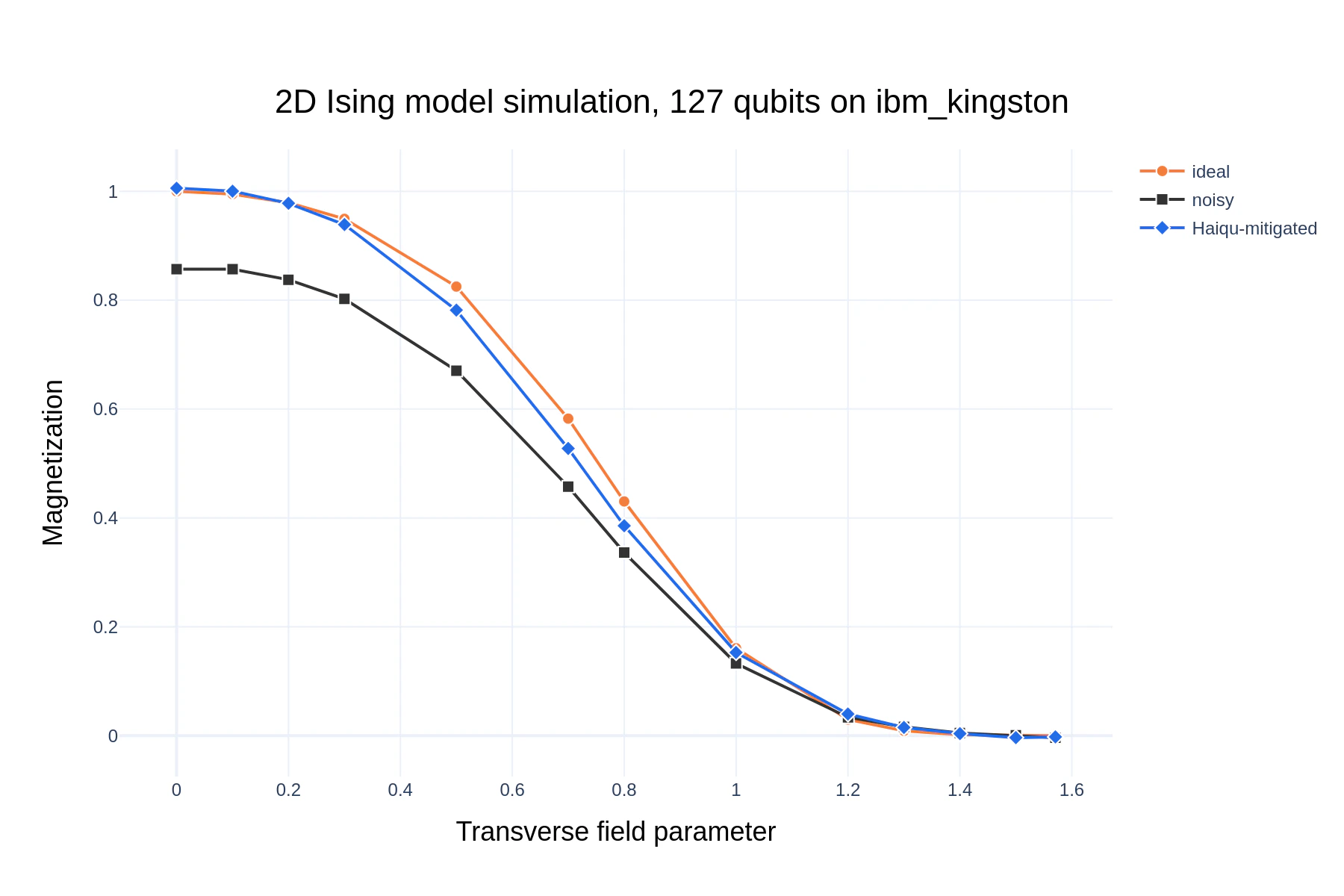
IsingModelSimulation.ipynb notebook.
Benchmark: GHZ state preparation
We prepare GHZ states on IBM Heron r2 processor by hardware-efficient circuits (found by breadth-first search (BFS) algorithm) with Haiqu’s bitstring distribution error mitigation.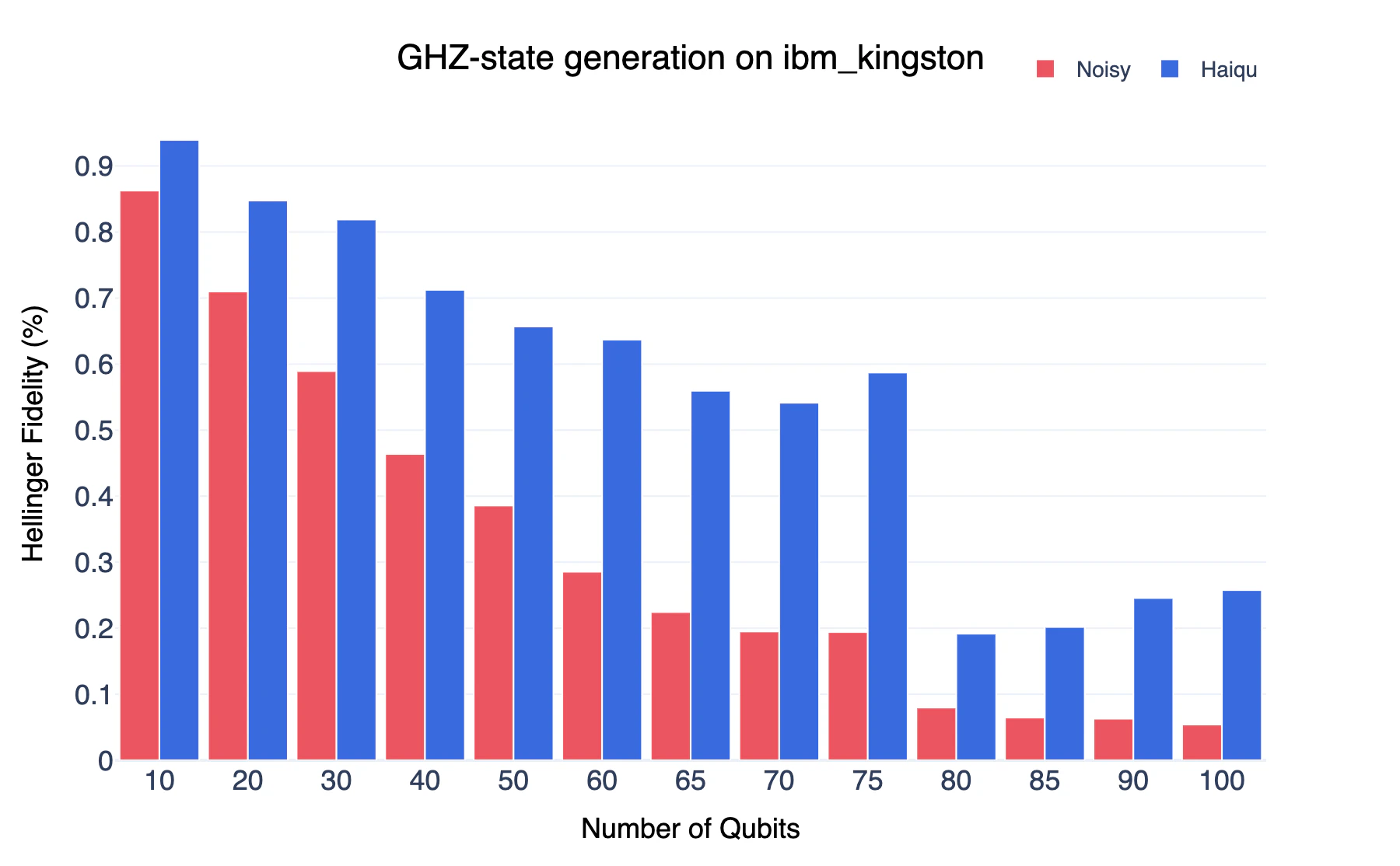
GHZStatePreparation.ipynb notebook.
Mitigation Loading Specifications
State compression
Benchmark: Utility-scale LR-QAOA
Following recent paper by Montanez-Barrera et. al. “Evaluating the performance of quantum processing units at large width and depth”, we use linear ramp quantum approximate optimization algorithm (LR-QAOA), a fixed-parameter, deterministic variant of QAOA, as a benchmarking protocol. Haiqu’s compression enables execution of nearly 20x more layers of LR-QAOA with the increasing approximation ratio.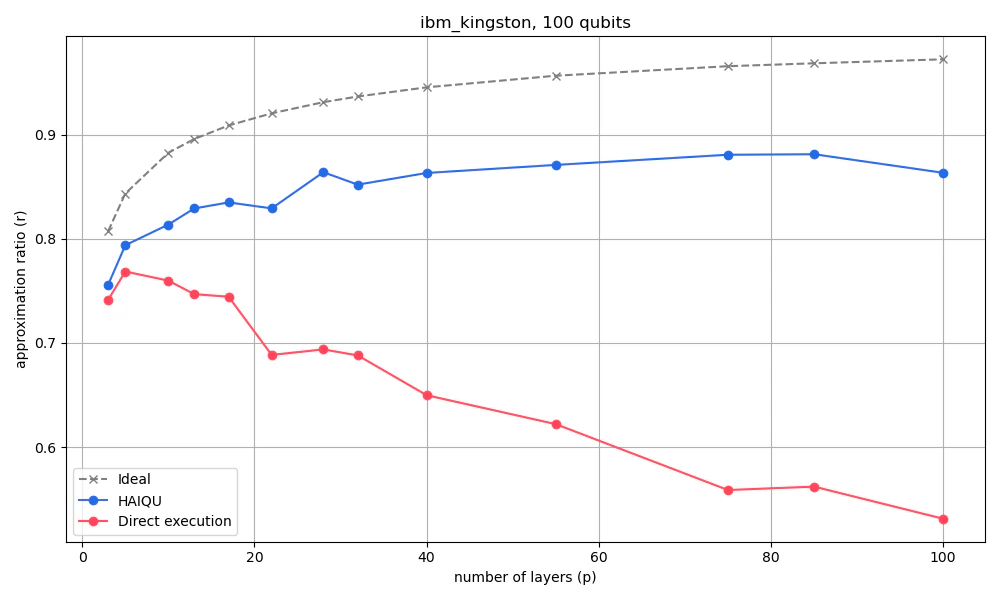
State Compression Specifications
*runtime can vary for different circuit classes of the same size