

job.result()the job result:
fidelity quantifies the overlap between a wavefunction generated by the synthesized circuit and the exact discretized input distribution, computed as quantum state fidelity.
The quality of the obtained data loading circuit can be visually verified using e.g. statevector simulation. For the Normal distribution example using num_qubits=8 we obtain the following result:
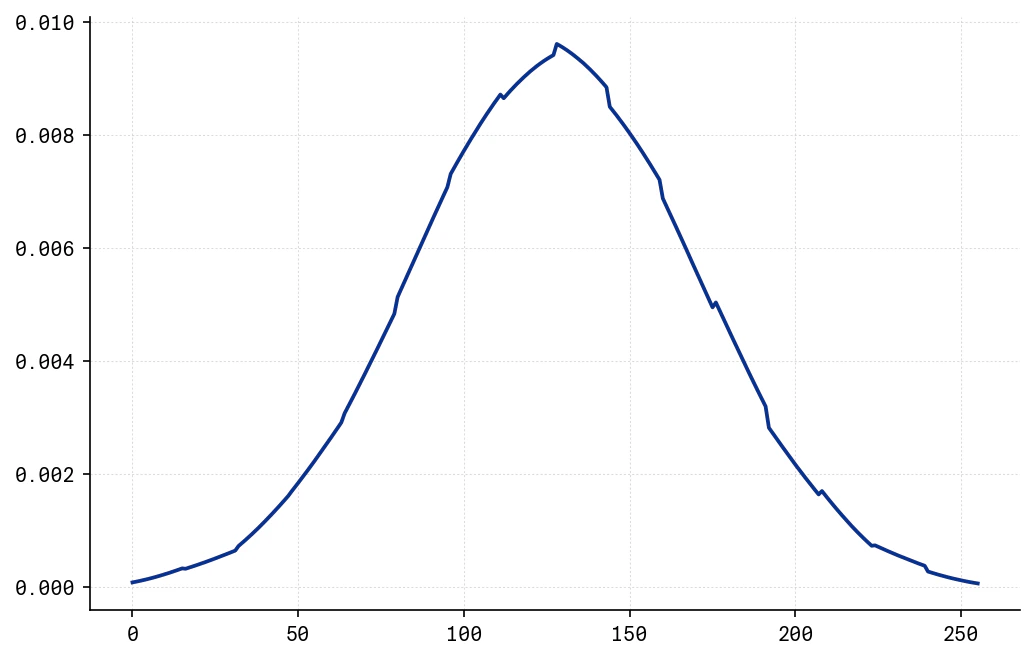
distribution_loading method are:
distribution_name:name of the statistical distribution fromscipy.stats.interval_startandinterval_end: the boundaries of the interval over which the distribution will be discretized before loading into the quantum state.num_qubits: the number of qubits used, which sets the discretization resolution.
loc(default: 00) → The location/mean of the distribution.scale(default: 11) → Scale or spread, often linked to variance.shapeparameters → Distribution-specific extra parameters. Check SciPy docs for details.
num_layers(default: 11) → Number layer in the data loading circuit. More layers = better approximation of data or distribution, but more gates.truncation_cutoff(default:1e-6) → A threshold for cutting off low-entanglement gates. Set toNoneor0for no truncation (full entanglement retained).